🏗️ 5a. Siebel Architecture
Siebel uses a classic 3-tier architecture: Presentation Layer, Application Layer, and Data Layer.
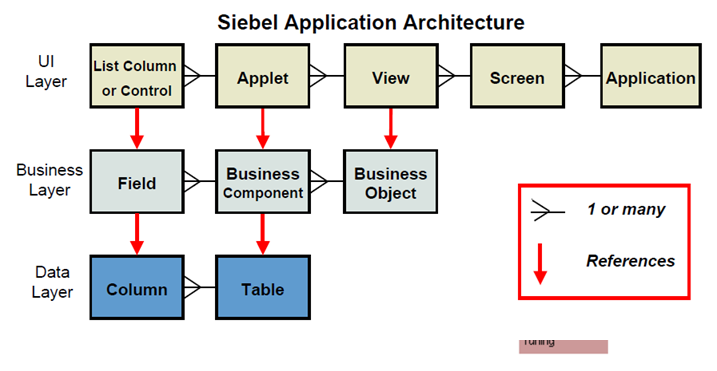
Three Architecture Layers
1. Presentation Layer (User Interface)
Purpose: Provides user interaction and displays business data
- Web Browser Client: HTML/JavaScript interface accessed via standard browsers (Chrome, Edge, Firefox)
- Mobile Applications: iOS and Android apps for field users and mobile workforce
- Open UI Framework: Modern JavaScript-based UI for customization and enhanced user experience
- Thin Client: No installation required on user devices, all processing server-side
Key Benefit: Users can access Siebel from anywhere - office desktops, home laptops, tablets, or smartphones - with consistent experience.
2. Application Layer (Business Logic)
Purpose: Processes business rules, workflows, and application logic
- Siebel Application Server: Core processing engine that handles all business transactions
- Object Manager (OM): Manages business objects (Accounts, Contacts, Opportunities) and enforces business rules
- Workflow Process Manager: Executes automated workflows (approval processes, SR routing, order fulfillment)
- Assignment Manager: Intelligently routes work items to appropriate users or teams based on rules
- Business Services: Reusable code components for integrations and custom logic
- EAI (Enterprise Application Integration): Connects to external systems (billing, ERP, provisioning)
Key Benefit: Centralized business logic ensures consistency across all channels and enables easy updates without touching UI or database.
3. Data Layer (Database)
Purpose: Stores all business and configuration data persistently
- Supported Databases: Oracle Database, Microsoft SQL Server, or IBM DB2
- Data Model: Comprehensive schema with 1000+ tables covering CRM entities:
S_ORG_EXT- Accounts/OrganizationsS_CONTACT- Contacts/PeopleS_OPTY- Sales OpportunitiesS_SRV_REQ- Service RequestsS_ORDER- OrdersS_PROD_INT- Products
- Repository: Stores Siebel metadata (views, applets, business components, workflows)
- Indexes & Partitioning: Optimized for high-volume data access and reporting
- Audit & Archive: Historical data tracking and compliance features
Key Benefit: Enterprise-grade database ensures data integrity, security, and supports millions of customer records with high performance.
How the Layers Work Together
Example: Agent Creates a Service Request
- Presentation Layer: Agent fills SR form in web browser → Clicks "Save"
- Application Layer:
- Object Manager receives request → Validates data (required fields, format)
- Workflow engine triggers → Assigns SR to appropriate queue based on issue type
- Business rules apply → Sets priority, SLA deadline, escalation rules
- Notification service → Sends email to assigned agent
- Data Layer: SR record inserted into
S_SRV_REQtable → Committed to database - Response: Application Layer sends confirmation → Presentation Layer displays "SR #12345 Created Successfully"
Advantages of 3-Layer Architecture
🔄 Scalability
- Add more application servers to handle increased user load (horizontal scaling)
- Database can be clustered for high availability
- Load balancers distribute traffic across multiple servers
🔧 Maintainability
- Update business logic without changing UI or database schema
- Deploy new features to application layer only
- Separate teams can work on different layers independently
🔒 Security
- Users never directly access database (application layer enforces security)
- Data encryption at rest (database) and in transit (SSL/TLS)
- Role-based access control applied at application layer
- Firewall isolation between layers
⚡ Performance
- Application layer caching reduces database queries
- Connection pooling optimizes database connections
- Static content (images, CSS, JS) served by web server, not application server
🌐 Flexibility
- Support multiple UI types (web, mobile, API) using same application logic
- Swap database vendors (Oracle → SQL Server) without changing application code
- Deploy across multiple data centers for disaster recovery